Josiah Graves
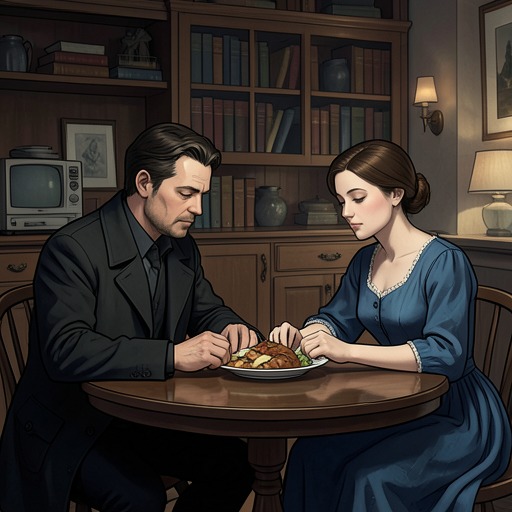
Of Human BondageJosiah Graves is Blackstable’s banker and a formidable lay authority in parish affairs: choir-master, treasurer, churchwarden, organizer, and, in practice, one of the people who keeps the local church running. Tall, thin, white-haired, and accustomed to acting without much consultation, he is at once useful to the Reverend William Carey and a persistent rival to the Vicar’s claim to authority. His long presence in the village gives him a part in its routines, its arguments over religious identity, and the final settlement of Carey’s estate.
Identity and Parish Authority
Graves manages the bank while also maintaining the parish accounts, arranging events for the choir and schools, and preparing for ceremonies such as a bishop’s visit for confirmation or a Rural Dean’s sermon at Harvest Thanksgiving. Blackstable takes pride in the choir he leads, even though the parish church has no organ. He does not wait for the Vicar to direct every detail: he acts on his own judgment, a practical independence that makes him seem to regard himself as the parish’s most important figure.
That influence is not merely ceremonial. When the Carey household’s limited finances are a concern, Graves is part of the parish’s everyday network of banking and local administration; his sister, Miss Graves, also serves as secretary of the Maternity Club, which assists poor pregnant women with flannel, baby linen, coal, and five shillings. The Graves family’s work thus reaches beyond church services into the organization of local support, even as the club’s connection to parish office makes its activities vulnerable to the Vicar’s disputes with his churchwarden.
Conflict with William Carey
Graves and Carey repeatedly rub against each other over the boundary between lay responsibility and clerical prerogative. Carey resents Graves’s managing ways, while Graves’s willingness to act without a full consultation undercuts the Vicar’s wish to be recognized as the parish’s leading authority. Carey privately calls him Bismarck, a nickname that turns the churchwarden’s administrative effectiveness into an image of overbearing rule.
Their sharpest quarrel begins when a Conservative candidate plans to address a meeting at the Mission Hall. Graves arranges the venue and reports that the candidate has asked him to chair the meeting. Carey objects that the Vicar, not the churchwarden, should preside when the Vicar is present, invoking the idea that the parish’s spiritual office makes him its proper person. Graves counters with the distinction between religious and political authority, arguing that the meeting belongs to the latter sphere. Carey then threatens to withhold the Mission Hall; Graves replies that the Wesleyan Chapel could serve instead. Carey says that if Graves enters what he regards as a heathen temple, he cannot remain churchwarden. Graves resigns all his offices and sends for his cassock and surplice.
The consequences expose how much the Vicar’s authority depends on the work he has displaced. Miss Graves resigns her secretaryship of the Maternity Club, and Carey initially declares himself master in his own house. He soon discovers that he must attend to responsibilities he does not know how to manage, while Graves realizes that he has lost his chief interest in life. After three weeks of anxiety, Carey and Graves reconcile. Their wives and sisters have discreetly exchanged letters and pressed each man toward the settlement each privately wants. The Mission Hall meeting goes ahead with a doctor as chairman, and both men speak. Each attributes the reconciliation to a shared love of their Redeemer, although the episode also makes clear their mutual dependence and the practical cost of their conflict.
Religious and Local Disputes
Graves’s disagreements with Carey extend from civic procedure to the appearance of worship. After Carey buys second-hand candlesticks in Tercanbury for the altar, Graves objects that they are popish. The objection strikes at a sensitive point: Carey sympathizes with some Roman Catholic forms, calls himself a Catholic, and resents being described as Protestant, while still occupying a low-church parish. He refuses to remove the candlesticks, muttering his private nickname for Graves rather than yielding.
Their contrasting positions show that authority in Blackstable is negotiated through more than formal office. Carey claims the precedence of the clerical role and seeks room for a more ornate worship; Graves acts as a guardian of the parish’s established practice and a forceful administrator. Neither is simply absent from the other’s domain. The Vicar’s power over the Mission Hall can obstruct a political meeting, but the churchwarden’s standing and competence make his resignation disruptive; a dispute over candlesticks similarly draws the limits of Carey’s liturgical preferences into view.
Graves also belongs to the recurring economy of Sunday church life. After services, he helps Carey count the collection, recognizes the usual contributions, and identifies an unfamiliar donor whose larger gift prompts the Vicar to consider asking for support for the Additional Curates Society. The scene is characteristic of Graves’s role: he attends to the records and patterns through which parish life is administered, while the Vicar interprets those details as opportunities for pastoral and institutional action.
Later Years and Carey’s Estate
When Philip Carey returns to Blackstable as an adult, Graves remains in his post and remains a foil to the Vicar. He has grown thinner and whiter and seems more austere, but he is still autocratic and still disapproves of candles on the altar. The persistence of these habits links Philip’s childhood memories to the parish’s later life: despite changes in the people around them, Graves and Carey continue to inhabit familiar positions of argument.
After Carey dies, Graves takes charge of the funeral arrangements, handling them in a manner described as both masterful and economical. He then returns to the vicarage with Philip, who is Carey’s nephew, and reads the will, which Graves holds. It leaves Carey’s property to Philip: the furniture, about eighty pounds in the bank, and investments including twenty shares in the Aerated Bread Company, as well as shares in a brewery, a music hall, and a London restaurant. Graves explains the commercial logic behind the investments, observing that people must eat, drink, and seek amusement. The holdings amount to about five hundred pounds; together with the bank balance and the sale of the furniture, they represent relief and a new financial footing for Philip. In this final service to the household, Graves’s practical stewardship again turns private need into an orderly settlement, while his investment choices reveal a shrewd accommodation with the ordinary appetites he otherwise regards as vulgar.